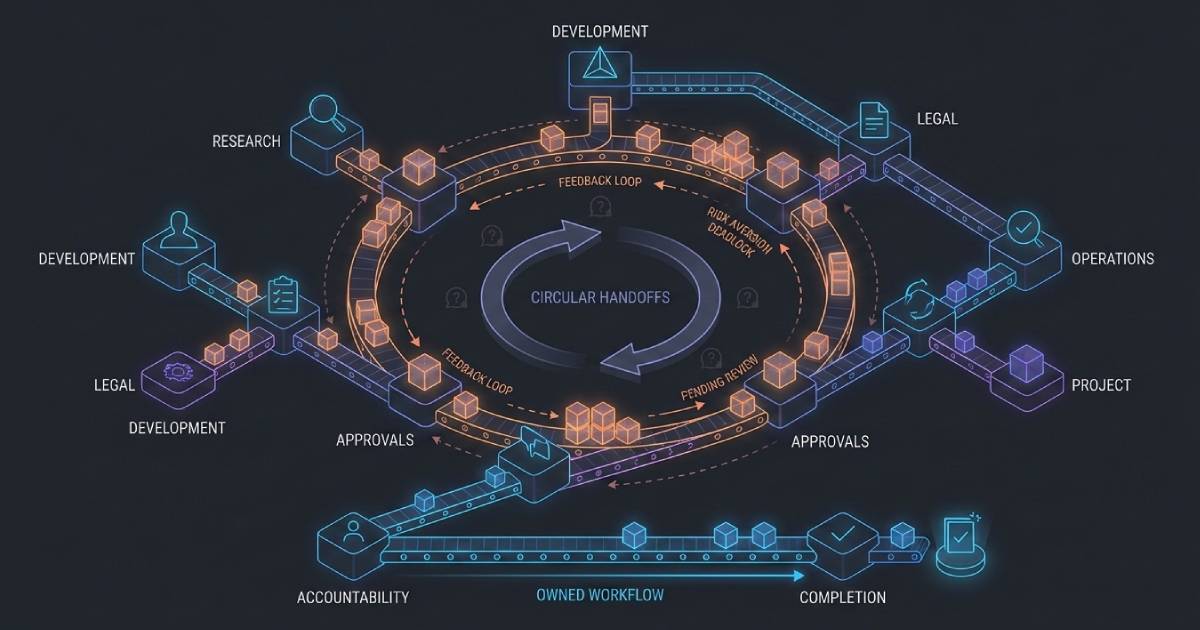
Imagine a routine production issue that cuts across multiple teams. At first, everyone moves fast: developers check recent changes, ops review deployments, and stakeholders start asking for updates. Then the tone shifts. Messages become defensive:
- “Nothing changed on our side.”
- “That component belongs to another team.”
- “We followed the spec.”
At that moment, ownership quietly disappears. The issue doesn’t linger because people lack skill or tooling; it lingers because no one feels fully responsible for the outcome. This is one of the most common—and costly—failure modes in technical organizations: when performance breaks down not at the technical layer, but at the human one.
Why do teams go defensive under pressure?
Many teams do everything “right” on paper. They meet deadlines, respect scope, document changes, and follow processes. Yet when something goes wrong, progress stalls. Instead of moving toward resolution, energy shifts toward protection. People retreat behind handoffs, runbooks, and polite escalation emails.
This usually isn’t a people problem; it’s a culture problem. When mistakes carry blame or reputational risk, humans behave predictably: they narrow responsibility and protect their surface area.
Psychological safety is a performance variable:
Teams that feel safe surfacing problems early and taking responsibility consistently outperform those that optimize for self-protection.
Do tools fix accountability gaps?
When incidents repeat, the instinctive response is often structural: new dashboards, more alerts, and stricter processes. Even modern architectures can make things worse if ownership isn’t clear. Microservices and domain splits can unintentionally encourage teams to optimize locally and disengage globally. Each team “owns” its component so tightly that no one owns the end-to-end experience.
"Tools don't determine who steps in or fix issues on their own; they only reveal where the fault lies. The rest is up to people."
Does the 'You Build It, You Run It' philosophy matter?
Simply, YES! Not because on-call rotations are magical, but because they force teams to care about outcomes beyond delivery. When the same team designs, ships, and operates a service, reliability stops being someone else’s problem. Fear decreases, learning accelerates, and fixes become proactive.
Speed doesn't come from more tooling. It comes from removing fear and unnecessary handoffs, and acting as one. Read more in Speed Is a System
How do high-performing teams treat ownership?
Strong ownership is not about heroics or doing everything alone; it’s about caring for the result from start to finish. In high-performing teams, ownership shows up in subtle but consistent ways:
- Sharing the outcome, not just tasks: When something degrades, the question is 'how do we fix this?' not 'who caused it?'
- Reaching beyond boundaries: Engineers help beyond their immediate scope because customer experience matters more than clean boundaries.
- Early surfacing: Risks are raised before they turn into incidents.
This mindset is visible across organizations known for sustained performance. Netflix pairs autonomy with responsibility. Google’s SRE model reinforces that service owners also run those services. At companies like Plaid and Dropbox, leaders are expected to step into cross-functional problems instead of passing them downstream.
Leadership’s real job is making ownership safe
Ownership doesn’t survive in environments where people are punished for mistakes. It must be intentionally protected through behavior, not just slogans:
- 1.Clear Responsibility: Every system needs a clearly accountable owner who ensures the whole thing works, not just someone who does the labor.
- 2.Empowerment to Act: Ownership without authority is just liability. Teams must be able to adjust priorities or fix issues without excessive approvals.
- 3.Modeling Accountability: When incidents happen, the response sets the tone.
Foster a Blameless Culture
A blameless post-incident culture signals that owning problems is valued above preserving optics.
This is where performance is won
Performance isn’t optimized by faster CPUs or shinier dashboards. It emerges from people operating in systems that reward responsibility. The fastest and most reliable teams win because someone immediately says: I’ve got this.
There’s no scramble to assign blame, no pause to negotiate ownership, and no waiting for permission. If you want better performance, stop starting with tools. Start with ownership.