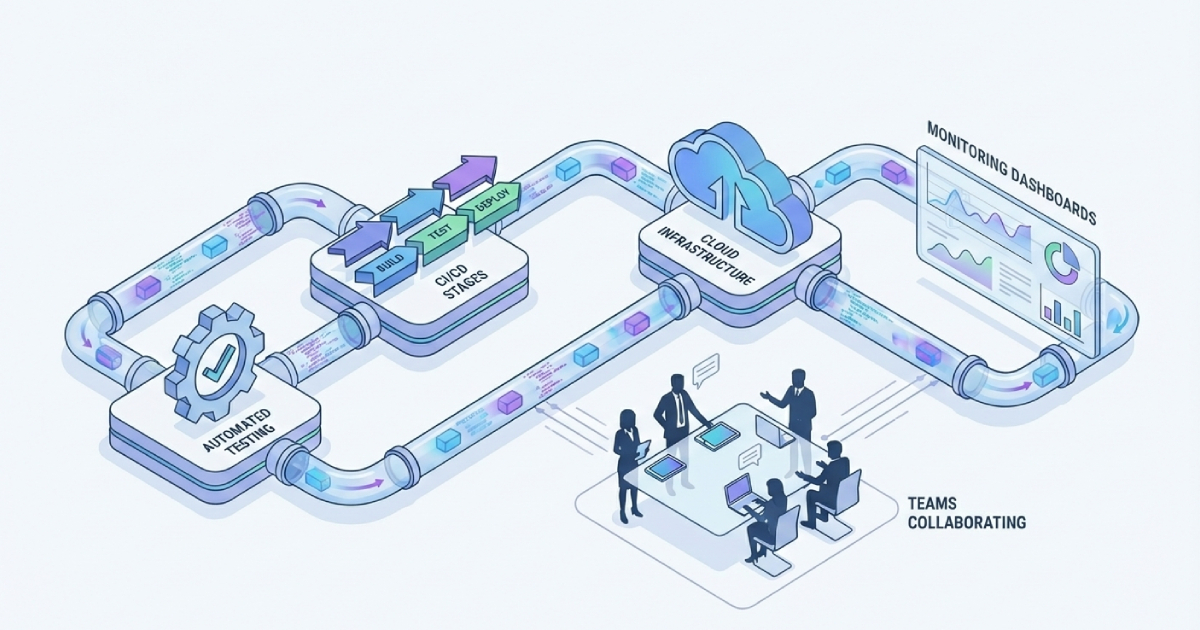
In software organizations, Time to Market (TTM) is often treated as a purely technical problem. The first reactions when the delivery slows down are predictable:
- "We need a better framework."
- "The codebase is too old."
- "We need stronger engineers."
- "We should rewrite this system."
Sometimes these assumptions are correct. But when we look at how high-performing technology companies operate, a different pattern emerges: technology is rarely the root cause of slow delivery.
The real bottleneck is usually how work flows through the organization. This insight explores how leading tech companies reduce TTM — when they change technology, when they change teams, and when they fix the system around them.
Time to Market is a Flow Problem or a Coding Problem?
From an engineering perspective, we measure cycle time — how long it takes to build a feature.
From a business perspective, what matters is lead time — how long it takes from idea to customer value.
In most organizations, actual coding represents only a small fraction of lead time. The rest is waiting: approvals, reviews, architecture decisions, environment access, and unclear requirements.
Flow Efficiency
High-performing organizations focus on flow efficiency, not just developer speed. If a task takes 2 days to code but waits 8 days for approval, doubling coding speed only improves TTM by 10%.
When tech changes help — and When they don’t?
"Technology does matter only when it solves a real constraint."
Leading tech companies do not change stacks simply because something is newer or because they have a huge waiting time. They change technology when:
- Infrastructure blocks automation
- Scaling is slow or expensive
- Deployment frequency is limited
- Developer experience is harming productivity
Netflix moved to cloud infrastructure to enable independent deployments and rapid experimentation. Shopify scaled millions of merchants on Ruby on Rails by investing in tooling instead of rewriting.
In both cases, technology supported the operating model.
When changing engineers is the wrong lever?
High-performing companies focus on enabling teams, not replacing them. Delivery speed is driven by clarity of goals, quality of product discovery, decision latency, team autonomy, and architecture — not by constantly rotating people.
"Replacing engineers inside a broken system usually makes things worse."
How high-performing tech companies operate?
Across Google, Netflix, Spotify, Amazon, and Meta, a consistent model appears:
- Small autonomous teams that own services end-to-end
- Strong internal developer platforms
- Continuous delivery by default
- Clear product direction
Spotify didn’t just break a monolith. They built internal tooling, standardized pipelines, and reorganized into autonomous squads. Architecture followed organization.
Process fixes beat stack changes
Many companies rewrite systems to “move faster” — and end up slower because rewrites alone do not remove approval chains, silos, manual testing, or unclear ownership. Without fixing those, the new stack becomes a newer version of the same problem.
A Practical view for technical leaders
Reducing TTM is not about choosing between technology or people, it is about aligning architecture, teams, tooling, delivery, and product direction. High-performing organizations design for:
- Fast decisions
- Fast feedback
- Fast learning
- Fast recovery
Conclusion
"Time to Market is not a feature of your framework, it is a property of your organization."
The fastest technology companies succeed because they build environments where engineers can move with confidence and autonomy. They invest in platforms, not just products. They fix delivery flow, not only code. And they optimize for learning, not for perfection.
That is the real and sustainable competitive advantage.
References
- 1.
- 2.
- 3.
- 4.
- 5.
- 6.
- 7.
- 8.